 HackingPassion.com
Bitly Links in Old Burger King and McDonald's Tweets Were Taken Over 21 Months After Bitly Reported a Fix
Ethical Hacking Complete Course Zero to Expert
Hack like black hat hackers. Penetration testing, Kali Linux, WiFi and web hacking, and the hacker mindset behind it.
→ Take the full courseA Burger King link from 2011 led to a list of Nazi concentration camps on November 15. Nothing was posted from the account. Someone remade the old Bitly link, 21 months after Bitly reported a fix.
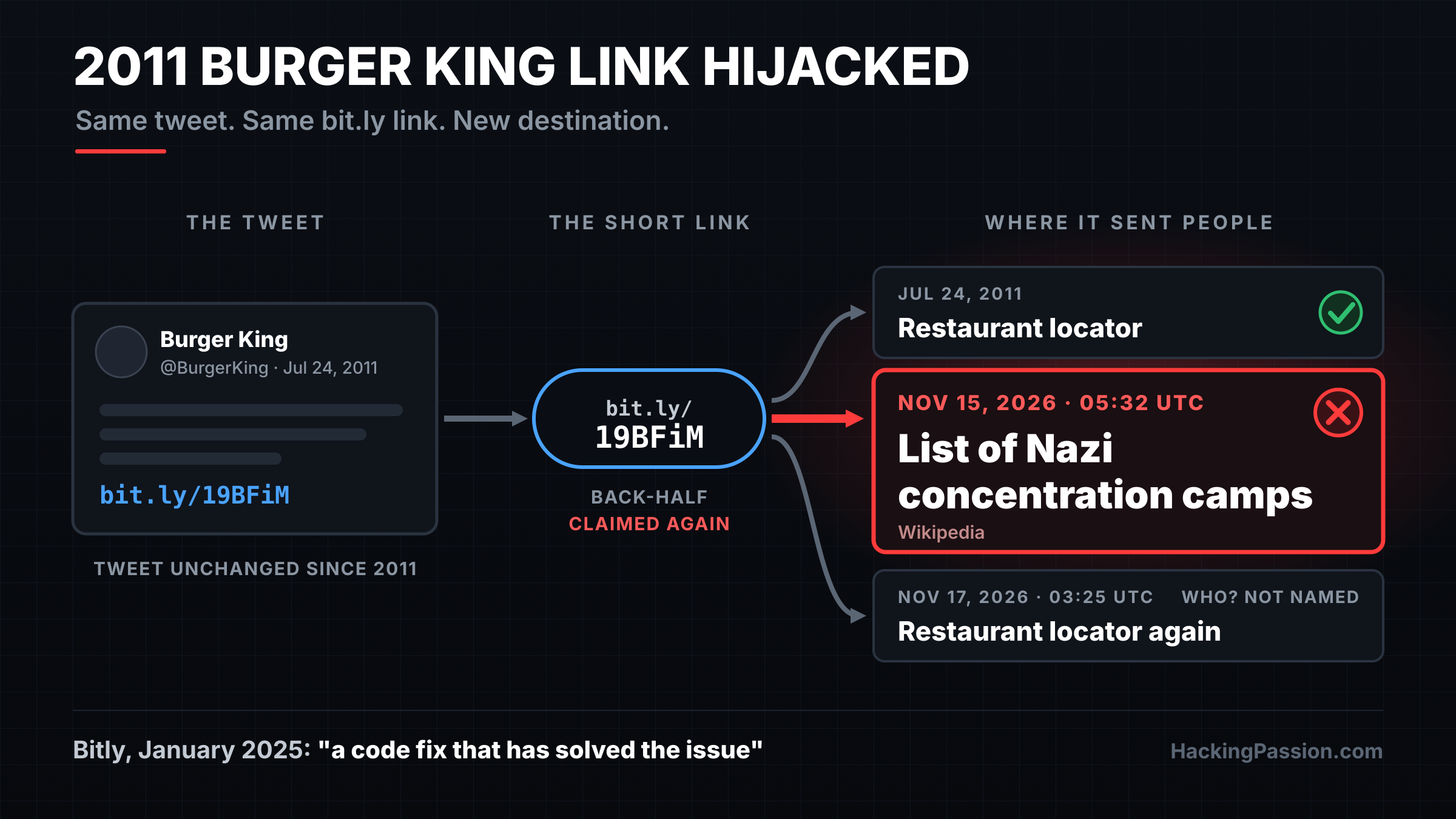
On July 24, 2011, Burger King posted a tweet about its restaurant locator, the page on its website that shows the nearest restaurant. The tweet carried a short link, bit.ly/19BFiM. On November 15, 2026, at 05:32 UTC, someone created that same short link again. From that moment on, the tweet from 2011 opened the Wikipedia list of Nazi concentration camps.
Eighteen minutes earlier, at 05:14 UTC, the same thing had happened to McDonald’s. A tweet from June 7, 2011, about an interactive billboard made by the McDonald’s team in Sweden, carried the short link bit.ly/mLWJO0. From that morning on, it opened the article on the September 11 attacks on the same site.
The tweets themselves stayed as they were in 2011, with the same text and the same date, and nothing was posted from either account. Burger King said it had nothing to do with where the links went, and that it was fixing or deleting the posts with those links.
At 06:51 UTC, 79 minutes after the link was made again, an account on X quoted the old tweet. By early afternoon that post had 2.2 million views, according to the researchers who rebuilt the timeline of that day minute by minute. At 13:45 UTC the original tweet inside it showed as unavailable. Two minutes later, the short link itself still led to the list of camps.
A short link has two parts. The first part, bit.ly, is the domain of the company that runs the service, Bitly. The part after the slash, 19BFiM, is called the back-half. Bitly keeps a record of which long web address belongs to which back-half. When someone clicks the short link, Bitly’s server looks up the back-half in that record and sends the browser on to the long address. That step is called a redirect, and it happens before the page itself starts to load.
You can watch that step without opening the page. The command below asks Bitly’s server for the short link and prints only the line that says where it sends you:
| |
The answer is one line, location:, followed by the long address. That line is all a short link is.
The tweet from 2011 only holds the short link. The address of the restaurant locator was never in the tweet. So whoever controls the back-half 19BFiM at Bitly decides where that tweet sends people today. The people behind this used accounts at Bitly, the same accounts Bitly later suspended. With those, they created a link with a back-half that had been used in 2011 and pointed it somewhere else.
Bitly lets its users pick their own back-half instead of a random one. According to Bitly’s pricing page, the free plan includes three of those custom back-halves a month. Which plan the people behind this used is not known.
According to Bitly’s own help pages, reusing an old back-half should not be possible. The page about what happens to links after an account is deleted was last updated on August 17, 2026, three months before the Burger King link changed. It says links on the bit.ly domain keep working after the account that made them is gone. Then it says: “The back-halves used on these links cannot be re-used.” That rule covers back-halves that were generated automatically and back-halves that were chosen by hand. The same page says Bitly deletes accounts on its own when they have been inactive.
At 19:13 UTC on November 15, Bitly posted a statement on X. It said it had “identified an issue that allowed bad actors to repurpose certain old, inactive links to redirect people to content unrelated to the original posts.” Bitly did not explain what the issue was. Readers added a note under the post that points to Bitly’s own documentation.
Burger King and McDonald’s were not the only ones. The links that were taken over sat in posts from 2009 to 2014, from companies, politicians and government accounts.
→ A second Burger King post led to the page on Adolf Hitler.
→ A 2013 post from McDonald’s Indonesia about a jingle led to an unrelated “Would you rather?” video on YouTube.
→ A 2010 post from Bill Gates about a trip to Washington led to a Reddit page with a fake post in the name of former New York mayor Michael Bloomberg.
→ A 2011 post from Justin Trudeau led to a vulgar audio clip.
Donald Trump’s personal account had at least a dozen posts that led somewhere else. A 2013 post against wind turbines opened a Google site called “fortnite baby” with a photo of a baby. A post about his golf course in Scotland opened a page on the Epstein files.
Also reported: a 2012 post from the FBI about computers infected in the Ghost Click case, which now led to a photo of a seal. A post from the US Department of Defense was redirected as well, and a post from Mike Pence led to the same seal page.
Ghost Click was the 2011 case against the gang behind DNS Changer. That malware changed the DNS settings on infected computers and home routers, the setting that decides which server turns a web address into the address of a machine. More than 4 million computers in over 100 countries were infected, about half a million of them in the United States, according to US authorities.
Paul Vixie’s organization ran the replacement DNS servers that kept those computers working until July 9, 2012. A post about traffic that was sent to the wrong place now sent its own readers to the wrong place.
The researchers who rebuilt the timeline went through 97 Bitly links in tweets from Trump’s account from 2009 to 2013. Bitly has a feature for that. Add a plus sign to the end of a short link, and Bitly shows a page with the destination and the date the link was created. A link in a tweet from 2011 with a creation date from this week is a link that someone made again.
40 of the 97 links were still the originals. One was blocked by Bitly as malicious or spam. Seven led somewhere other than the tweet suggested.
Four of those seven were registered on November 15 itself, between 07:49 and 09:57 UTC, and led to a Roblox profile, a video twice and an article on Trump and Jeffrey Epstein. Two had been created in January 2024 and January 2025 and led to web addresses whose names copied crypto services. One, from January 29, 2025, led to test.com. The link from January 2024 sat in a tweet on the president’s account for almost three years before it was switched off.
The day started earlier than the Burger King link. Two more links from that account, from 2013 and 2012, were created again at 23:52 UTC on November 14 and at 01:04 UTC on November 15. At 09:18 UTC a user on X explained the method in public. Three of the four links from that day followed in the next 40 minutes, at 09:36, 09:47 and 09:57 UTC.
This had happened before. In late January 2025, Bitly links in old posts from the same account were taken over to promote new memecoins, crypto tokens listed on a site called pump.fun. A 2013 post that said “Follow me on Instagram” sent people to a coin called DJT, which at one point reached a market value of 1 million dollars. At least one link in a 2013 post from Melania Trump was taken over too.
On January 30, 2025, Bitly wrote on X: “Earlier today, Bitly identified a bug that bad actors used to repurpose old, inactive links”. Shortly after came a second post: “Our engineering team implemented a code fix that has solved the issue.”
Twenty-one months and one fix later, on November 15, Bitly used almost the same words again. Whether it is the same bug or a new one, Bitly has not said.
The 97 links also showed something that is still running. 49 of them had been created again after the tweet and led where the tweet suggested. 48 of those were created on May 26, 2023, between 14:55 and 15:12 UTC, in 17 minutes. Who created them is not known. Because they go where they should, they look harmless, and at 23:35 UTC on November 15 they were still working. They sit in tweets from the account of the man who is now president.
The tweets are only the part that got seen. A short link also ends up in emails, PDF files, presentations, and on printed QR codes on posters and packaging. Bitly’s help page describes a QR code made in Bitly as a scannable form of a short link. Whoever controls the back-half controls where that printed code sends people, and a code on a poster cannot be updated.
This kind of attack has a name: broken link hijacking. A page or a post points to something outside itself, such as a domain or a short link. When that thing stops existing and someone else claims it, the visitors go to the new owner. The tweet keeps the trust it always had, because it still comes from the account of the company itself.
In October I wrote about the same pattern in Popcorn Time. Up to 3 million Windows PCs and 350,000 Macs kept asking for updates to a movie app from 2014 at web addresses that were no longer registered. A security company registered those addresses, and the requests went to that company instead.
By 19:22 UTC on November 15, both links showed Bitly’s “Link Deactivated” page, and none of the seven links in the president’s old tweets that led somewhere else redirected anymore. Bitly said it had suspended the accounts involved and was disabling the affected links. Its Trust and Safety team is working “to address the issue and strengthen protections against similar misuse in the future.”
On November 17, I opened the info pages of both links myself. bit.ly/19BFiM led to the restaurant locator again, and Bitly gave it a creation time of November 17, 2026, 03:25 UTC. bit.ly/mLWJO0 led back to the billboard article, created at 03:39 UTC the same night. That restored address even carries the tracking code a news feed added to it in 2011, so whoever restored it had the original record.
The back-half from 2011 has now been created three times: by Burger King in 2011, by whoever pointed it at the camps on November 15, and by someone in the early hours of November 17. Bitly has not named who that was.
What you can do:
→ Before you click a bit.ly link in an old post, add a plus sign to the end of it. The page shows the destination and the creation date. A creation date that is much later than the post itself means the link was made again.
→ If you run accounts or websites for a company or a school, make a list of the short links in old posts, newsletters, PDF files and printed material. Then check where each one goes today, and start with posts that give payment details or official notices.
→ Remove links in old posts that no longer lead anywhere useful, or replace them with the full address.
Want to learn how to find the forgotten links in old posts and documents before someone else claims them? My Ethical Hacking Complete Course Zero to Expert takes you there step by step: reconnaissance, scanning, exploitation and traffic analysis, hands-on, from your first day with no Linux or hacking background.
→ Join my complete ethical hacking course
Hacking is not a hobby but a way of life.
Sources:
Bitly statement on X | Bitly Help Center | Bitly fix, January 2025
Stay updated
Get the latest posts in your inbox every week. Ethical hacking, security news, tutorials, and everything that catches my attention. If that sounds useful, drop your email below.