 HackingPassion.com
Retadup USB Worm Returns Seven Years After French Police Shut It Down
Ethical Hacking Complete Course Zero to Expert
Hack like black hat hackers. Penetration testing, Kali Linux, WiFi and web hacking, and the hacker mindset behind it.
→ Take the full courseA USB worm that French authorities shut down in 2019 spread again on Windows PCs, seven years later. One click on a folder was enough. This time it carried malware that unpacked itself on the graphics card.
In August 2026, Kaspersky found a new version of CoffeeLoader, a piece of malware whose job is to get onto a Windows PC and then download whatever its operators send next. Loaders like this usually arrive through email, fake download sites, malicious ads or pirated software. This one came in through Retadup, a worm that spreads over USB sticks and external drives, and that French police took offline in the summer of 2019.
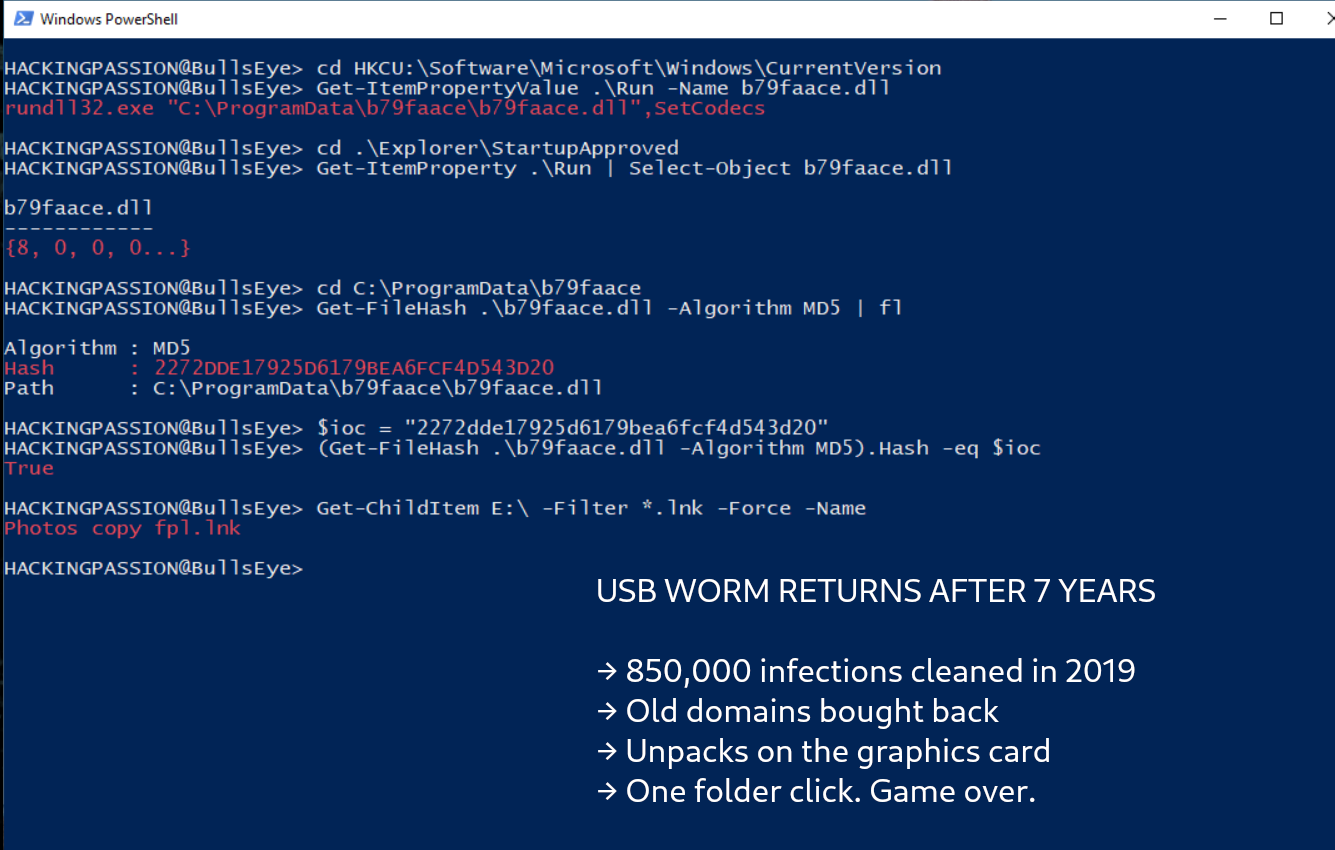
Once Retadup runs on a PC, it copies itself as hidden files to the USB flash drives and external drives that are plugged in. For each folder on the drive, it puts down a shortcut, a small .lnk file that carries the folder’s name and looks like it. On the next PC, the drive looks almost the way it always did. A click on what looks like one of those folders starts the worm, and that PC is infected too, along with the next stick that goes into it.
Retadup first turned up in June 2017, in hospitals in Israel. Trend Micro found it there posing as a Windows updater, in a folder on the C: drive called C:\WinddowsUpdated, with two d’s. That first version stole saved passwords from Firefox, Opera and Chrome, recorded keystrokes, took screenshots, and searched the PC for shortcuts named after payment services such as PayPal and Western Union.
The worm was written in AutoIt, and later also in AutoHotkey, two free tools for automating tasks on Windows. Each infection consists of two files: the clean program that runs scripts, and the malicious script it runs.
By April 2018, the operators had found a different way to earn from it. A new version put XMRig on infected PCs, a program that mines the cryptocurrency Monero, and ran it inside processes such as Notepad and Explorer. The processor of each infected PC did the mining, and the coins went to the operators. The servers for that version sat on web addresses such as alphanoob.com, radnewage.com and newminersage.com.
The person who said they built it did not hide. On a throwaway Twitter account, @radblackjoker, they called Retadup their baby, wrote that they had invented the worm, and added that they would rule the world one day. The account also posted a screenshot of the worm’s control panel. When the researchers who later took Retadup apart got hold of the source code of its servers, the code showed that the screenshot was genuine.
The same nickname, rad, shows up in the paths on those servers. The researchers who first found Retadup traced its code back to the rad worm, which was passed around on criminal forums as a finished package in 2014. They also found a part in it written by another malware author.
In March 2019, Avast started following Retadup closely. Its researchers found that most of the worm’s servers were in France, and at the end of that month they contacted C3N, the cybercrime center of the French Gendarmerie. The programs on the operators’ own server turned out to be infected as well, with Neshta, a virus that attaches itself to program files.
The researchers had also found a design flaw in the way the worm talked to its server. Whoever controlled that server could send infected PCs an answer that made the worm remove itself, and the victims did not have to run any extra code for it. In July 2019, the police took over the servers and replaced them with a server of their own. One of the investigators explained in a 2020 interview how it worked: they made the worm believe an update was waiting, and the update they served was an empty file.
At the end of August 2019, the result went public. More than 850,000 infections had been cleaned up, most of them in Spanish-speaking countries in Latin America. The investigators counted infections in 140 countries, and a few hundred computers in France itself.
On one wallet alone, the researchers counted 53.72 Monero mined in nearly a month, about 4,200 dollars at the time. They expected the total to be higher, because the operators may have mined through other routes as well. On some PCs, the researchers also saw Retadup install the Stop ransomware, which locks files and asks for money to get them back, and Arkei, a program that steals passwords.
The cleanup only reached PCs that contacted the server while the police were answering. A PC that stayed offline, or a stick that sat in a drawer, never got that answer.
One of the investigators also said in 2020 that the worm’s domains had been redirected to a sinkhole, a server that takes in the traffic so it no longer reaches the operators.
In the official .com registry, two of the addresses from 2018, alphanoob.com and radnewage.com, were registered again on June 19, 2024, within 47 minutes of each other. Both went through the same registrar, a company that sells domain names. On July 4, 2026, at 17:50 UTC, both registrations were changed. At 18:23 that same evening, newblackage.com, newminersage.com and minernewage.com were registered at a second registrar, all three within the same minute. Fifteen days later, on July 19, internet-speed-check.com was registered at that second registrar. That is the address CoffeeLoader now gets its orders from.
According to the researchers who found the new version, someone started registering the old Retadup addresses again two years ago. At first, those servers handed out SmokeLoader, another loader. In early 2025, the same servers switched to CoffeeLoader.
And the old worms answered. The researchers watched a Retadup version from 2017 contact noobminer.newblackage.com. On August 6, 2026, the server told it to sleep. On August 10, it told it to download a file called update.exe from rurjfvn.rs. The commands are plain text, turned into Base64 and then into hexadecimal, two common ways of writing data as ordinary letters and numbers. The worm has used that same simple format for years.
This time the numbers are smaller. In the first three quarters of 2026, the researchers’ own security software blocked Retadup infection attempts on around 15,000 systems, most of them in Peru, Angola, Russia and Bolivia. Those are blocked attempts, and they only cover PCs that run that software. How many PCs were infected, the researchers do not say. Peru is not new. In 2019, the worm’s own server kept a separate count of the victims from Peru.
What the worm downloads now starts with an installer built with NSIS, a free tool for making Windows setup programs. The installer drops a file called 7z.dll into a temporary folder and starts it with rundll32.exe, the Windows program that runs code from DLL files, the library files that Windows programs share.
That 7z.dll is a copy of the library that comes with 7-Zip, the archive program, with part of its code replaced. The archive program itself has no flaw here. The replaced part is wrapped in Armoury, a packer: a layer of encryption that keeps security software from reading the malware until it unpacks itself on the PC. Zscaler named it in March 2025 because it posed as Armoury Crate, a utility from ASUS.
Armoury hands that unpacking to the graphics card. The older version used OpenCL, a standard way for programs to run calculations on the GPU. The new version uses OpenGL, the interface that games and 3D programs use to draw on screen. It runs a small program on the GPU, called a compute shader, that unscrambles the hidden code with a key and hands the result back. The researchers who named Armoury wrote in 2025 that this GPU step may make analysis harder in virtual machines, the test PCs where researchers run malware to see what it does.
The unpacked code is a downloader, the part that installs CoffeeLoader and fetches the rest. It copies 7z.dll to C:\ProgramData or to the user’s AppData\Local folder, into a folder with an eight-character name such as b79faace, and gives the file that same name. Those eight characters are calculated from information about the PC’s system drive.
Then it makes sure it starts again after a reboot. It adds an entry to the Run key, the list in the Windows registry of programs that start when the user logs in. That entry starts the DLL through rundll32.exe and a function called SetCodecs. It also writes a value under StartupApproved\Run, the place where Task Manager keeps track of which startup items are switched on or off. With that value in place, the entry cannot be switched off there.
After that, it starts one of five programs that come with Windows, dllhost.exe, WerFault.exe, svchost.exe, OpenWith.exe or AtBroker.exe, and moves its own code into it. From there it fetches its next part over HTTPS from api.internet-speed-check.com, posing as Firefox. It only runs what comes back if two checks pass. The first is a digital signature, a mark that only the holder of a secret key can make. The second is a checksum, a number that shows the code arrived unchanged. Only whoever holds that secret key can give it orders. The code then runs in memory.
The server was still handing out code at the end of September. In the traffic example in the new report, it answered on September 29, 2026 with 60,800 bytes of signed code. That answer came through Cloudflare, so the address of the server behind it stays hidden.
The version found in August uses a new marker in its network messages, 0xD1D57871. The old one was 0xC0FFEE42, which reads as C0FFEE.
CoffeeLoader itself does one job. It runs what its server sends: it moves that code into another running program, saves it as a program and starts it, or saves it as a DLL and starts it through rundll32.exe. The researchers do not say what the operators sent in 2026. The March 2025 report that named Armoury showed CoffeeLoader delivering Rhadamanthys, malware that steals passwords and other data from the PC. That version also had a fallback for when its servers could not be reached. It calculated a new .com address from the date, one for each day, and tried that one instead.
The worm needs that click on the shortcut because Windows no longer starts programs from a USB stick on its own. In February 2011, Microsoft started offering update KB971029 through Windows Update. It limits AutoPlay to CDs and DVDs and stops it on USB drives, external hard drives and network shares. So Retadup waits for a person to open something, and it makes that something look like a folder.
In cybersecurity, attribution is one of the hardest problems. An expired domain name goes back on sale, and whoever pays for it gets it. What we know for sure is how the malware works and when the addresses were registered, not who registered them. The researchers write that they do not know whether the worm’s author or someone else brought the servers back. None of the sources names a suspect or an arrest.
What to check on a Windows PC:
→ In File Explorer, switch on hidden items and file name extensions. On a USB stick, a
.lnkshortcut that carries the name of a folder, sometimes with a few extra characters after it, next to hidden files, is the pattern Retadup leaves. Do not open the shortcut.→ In Command Prompt, list the startup entries for your own account and for the PC. Look for
rundll32.exestarting a DLL from a folder with an eight-character name inProgramDataorAppData\Local:
| |
- → Once the stick has been scanned and cleaned, the hidden files and folders can be made visible again with
attrib. Replace E: with the letter of the stick:
| |
The indicators the researchers published:
→ Retadup servers: alphanoob[.]com, newblackage[.]com, newminersage[.]com, radnewage[.]com, minernewage[.]com, rad2016.publicvm[.]com, radpal.publicvm[.]com, roro2016.linkpc[.]net
→ CoffeeLoader server: internet-speed-check[.]com
→ Download locations: rurjfvn[.]rs/update.exe and alphanoob[.]com/update.exe
→ MD5 of the installers: 58886d45a0c5e802a5d0a7545c36112d and cca710c5455c1fe2732771afbac16a09. MD5 of the DLL files: 2272dde17925d6179bea6fcf4d543d20, dce55eec553f6af16ba6481eaacb8638 and 449c9e8bc6eb308aa3c46c88959e1a4f
Want to see how malware survives a reboot? Set up a Windows virtual machine in VirtualBox and watch its Run keys while you test.
My Ethical Hacking Complete Course Zero to Expert takes you there step by step: reconnaissance, scanning, exploitation and traffic analysis, hands-on, from your first day with no Linux or hacking background.
→ Join my complete ethical hacking course
Hacking is not a hobby but a way of life.
Sources:
Kaspersky Securelist | Avast Threat Labs | Zscaler ThreatLabz
Stay updated
Get the latest posts in your inbox every week. Ethical hacking, security news, tutorials, and everything that catches my attention. If that sounds useful, drop your email below.