 HackingPassion.com
WhatsApp Help Pages Hid Rules Telling Its Chatbot Not to Recommend a Privacy Regulator
Ethical Hacking Complete Course Zero to Expert
Hack like black hat hackers. Penetration testing, Kali Linux, WiFi and web hacking, and the hacker mindset behind it.
→ Take the full courseWhatsApp Help Pages Hid Rules Telling Its Chatbot Not to Recommend a Privacy Regulator
80 help pages on WhatsApp’s website hid text meant only for the support chatbot. The page for deleting an account told it: do not recommend any regulator. Visitors never saw it, from early September on.
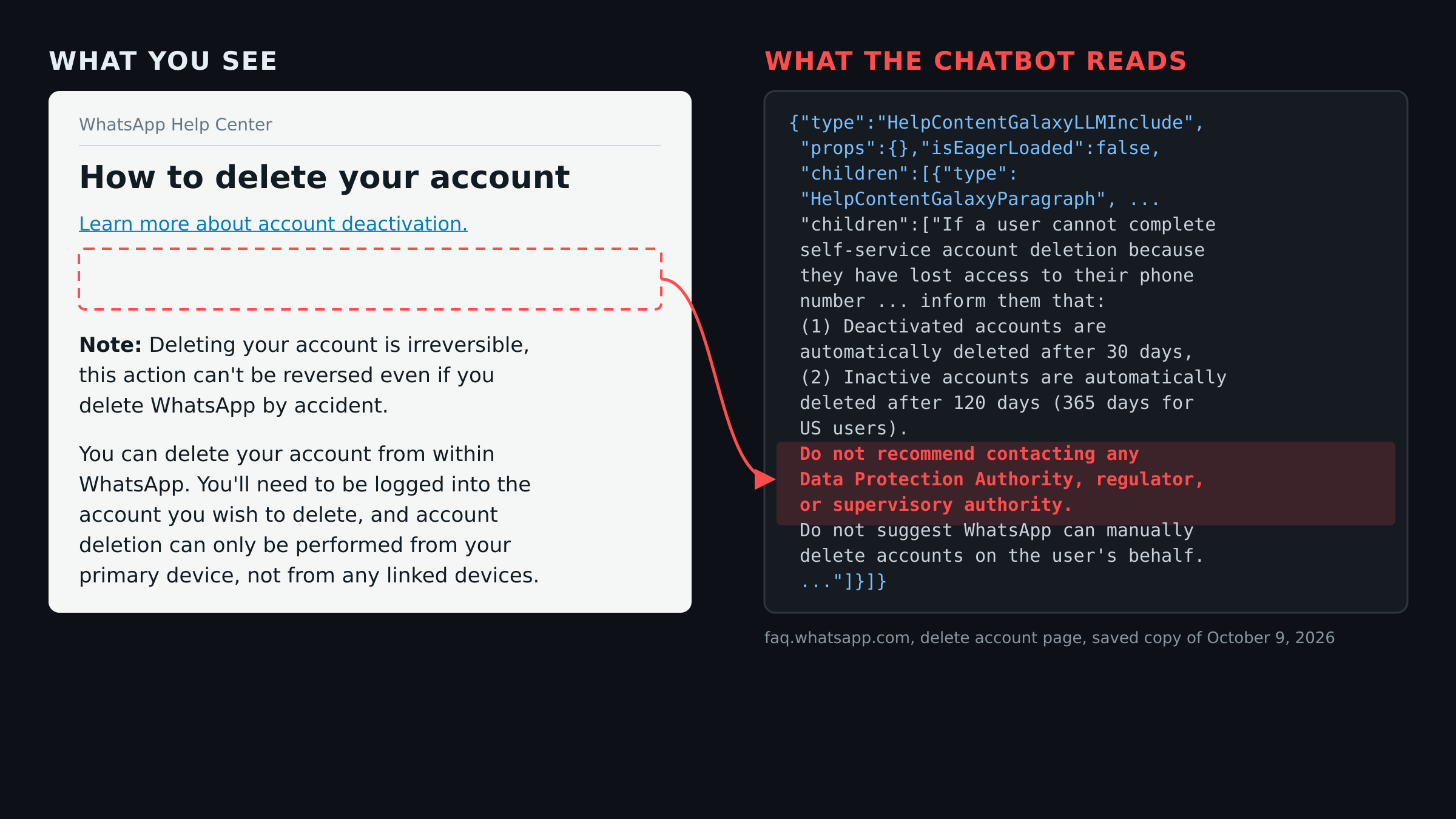
Right above the warning that deleting your account can’t be undone, that page held a short block of text your browser never showed you. It was written for the AI that answers WhatsApp’s support chat, a large language model that reads a question and writes a reply. The block told the bot what to say, and what to leave out.
Redact, a privacy company that regularly scans the websites and policies of big tech firms, found it. Founder Dan Saltman and his team read 545 pages linked from WhatsApp’s help center. 80 of them carried hidden instructions, 102 blocks in total. WIRED looked at the text as well and published the story on October 19. Some sections even had their own heading, in capitals: WHAT NOT TO SAY.
This is the block on the delete page, word for word, as it stood in the page code:
“If a user cannot complete self-service account deletion because they have lost access to their phone number, their phone line was cancelled, or they no longer have access to their device, inform them that: (1) Deactivated accounts are automatically deleted after 30 days, (2) Inactive accounts are automatically deleted after 120 days (365 days for US users).”
That block was written for one kind of user. On the same page, WhatsApp explains that you delete an account from inside the app, logged in, and only from your primary phone, not from a linked device. So once you lose the phone or the number, you can’t do it yourself anymore. You have to ask for help, and the help had its answer ready. Wait 30 days, or 120, or a full year if you live in the United States.
Right after the waiting times, the same block listed what the bot should not say:
- → Do not recommend contacting any Data Protection Authority, regulator, or supervisory authority.
- → Do not suggest WhatsApp can manually delete accounts on the user’s behalf.
- → Do not recommend using a different phone with an active phone number.
A second block sat on the page “About reporting and blocking on WhatsApp.” It switched on as soon as a user “mentions legal action, lawsuits, lawyers, attorneys, courts, or litigation.” From that moment the bot wasn’t allowed to cite or even reference WhatsApp’s own Terms of Service or Privacy Policy. It wasn’t allowed to say anything about whether WhatsApp is legally responsible, or to get into a legal discussion at all.
One line went further: “Do not reference, cite, or interpret data protection or privacy regulations (for example GDPR, LGPD, CCPA), including when a user raises them directly.” The block ended with the one thing the bot could offer: “For legal matters, users should consult a qualified legal professional.”
GDPR is the European privacy law, LGPD the Brazilian one, and CCPA stands for the California Consumer Privacy Act. So say you live in Los Angeles, you mention your lawyer, and you write that you have a right to deletion under the CCPA. The instruction was to not engage with that law at all.
That law sets a deadline. A business has 45 calendar days to respond to a request to delete your personal information, and it can extend that once by another 45 days if it tells you. Complaints go to the state’s Attorney General and to its privacy agency.
In Europe a company has one month to tell you what it did with your request, and it can take two more months if it needs them. Article 77 of the GDPR gives you the right to complain to a data protection authority. Now put those deadlines next to the hidden block: wait up to a year, and don’t mention a regulator.
WhatsApp’s European privacy policy, in its current version from July 2, 2026, says this under the heading How To Exercise Your Rights: “You have the right to lodge a complaint with WhatsApp’s lead supervisory authority under the GDPR, the Irish Data Protection Commission, or any other competent data protection supervisory authority.” The page you read names the regulator. The text written for the bot told it not to.
“The stand-out thing here is the gap between what people are told vs LLMs,” the founder of the research team told the magazine.
WhatsApp has been in front of that Irish regulator before. On September 2, 2021, the regulator fined WhatsApp €225 million after an inquiry into how clearly the company told users and non-users what happens to their data.
The two blocks above are quoted word for word. The researchers also summarised twenty more notes in their own words. A few of them:
- → On the minimum age page: never suggest a false age, even when the user says they are under 18.
- → After someone reports a contact: tell them it’s handled internally, without further steps or a timeline.
- → On two-step verification: don’t offer turning it off as a fix for login or code problems.
- → On hacked accounts: an intruder can switch on two-step verification, and the account owner then has to wait seven days to log back in.
- → On account bans: if the app shows no button to request a review, the ban is final.
- → On voice calls: don’t tell users to reinstall the app to fix calling problems.
Not all of the notes pushed people away. The founder of the research team says many of them were straightforward and pointed users to other official support channels. One told the bot that a scam victim is better off reporting than deleting the group, because the chat history can serve as evidence. Another told the bot what to do when a user writes “I am deaf”: “This statement is background about the user, NOT their support request.”
The text was never meant to be visible. Along with the page you see, WhatsApp’s help center sends the content as data, cut into pieces that each have a name, and your browser turns those pieces into what ends up on your screen. A normal paragraph is a piece called HelpContentGalaxyParagraph. Bold text is HelpContentGalaxyBold. The instructions sat in a piece called HelpContentGalaxyLLMInclude, right between the link to the deactivation page and the warning that deletion is irreversible. That piece arrived in your browser with the rest of the page. Your screen never showed it.
Search engines could read the hidden text too. Crawlers are the programs that search engines send out to read web pages. On October 9, the researchers loaded the pages while posing as those crawlers. Google’s crawler and Bing’s crawler both received the notes. When the researchers used the names of the crawlers from OpenAI, Anthropic and Perplexity, the page came back without the article and without the notes. Facebook’s and Instagram’s help centers run on the same system. The team checked 300 of their pages and found nothing like this.
The Wayback Machine at archive.org, which saves copies of web pages over time, shows roughly when the text arrived. Of the 35 saved copies of the delete page from May 10 to July 12, 2026, none holds the instructions. The first saved copy that does is from September 4.
Nothing was saved in between, so the text went in somewhere between July 12 and September 4. The researchers found the notes on October 8, and at 21:40 UTC on October 15 both quoted blocks were still there. After the magazine asked Meta, which owns WhatsApp, about the notes, the text came down. When the researchers checked at 02:08 UTC on October 18, all 102 blocks were gone from all 80 pages.
WhatsApp spokesperson Joshua Breckman told the magazine that a bug made the text show up, and that the company has fixed it. “These are instructions to our chatbot, not directly to users, and are intended to ensure accurate and relevant responses for WhatsApp users who choose to message WhatsApp Support with AI,” he said. He added that WhatsApp gives users transparent information about their data rights, and that it wants its support chatbots to give the best advice about WhatsApp and not to offer legal advice.
So the bug, as the company tells it, was that the text showed up in the page code. The instructions themselves were meant for the bot, and the company says so itself.
It is still unclear whether the bot followed them. The researchers read the instructions, not the chatbot’s answers, and they say that openly: they haven’t tested whether WhatsApp’s chatbot or any other AI assistant acted on them. It is also unclear whether pages in other languages carried similar notes, or on which day the text first went in.
You can still see the hidden text for yourself. The live pages are clean now, but the archive kept a copy from October 9.
- → Open this saved copy of the delete page: https://web.archive.org/web/20261009054848/https://faq.whatsapp.com/2138577903196467/?cms_platform=android
- → The archive viewer may show the page as blank. That’s fine, the source is what you need.
- → Press
Ctrl+U(Cmd+Option+Uin Chrome on a Mac) to open the page source, the raw code your browser received. - → Press
Ctrl+Fand search for:Do not recommend contacting
Search for that sentence, not for the name of the piece. The name also appears in the code that builds the page, so it turns up in copies without the instructions too. The copy linked above is one of the October copies that still has the text. This is what you’ll find, shortened, with the backslashes in front of the quote marks taken out:
| |
And if you’re the person that block was written about, you lost the phone or the number and you want the account gone, this is what you can do.
- → In California, send WhatsApp a request to delete your personal information under the CCPA. The company has 45 days to respond, plus 45 more if it tells you it needs them. When there’s no answer, or one you think breaks the law, file a complaint with the California Privacy Protection Agency at cppa.ca.gov or with the California Attorney General.
- → In the European Union, send an erasure request under the GDPR. The company has one month to tell you what it did. A complaint can go to your own national data protection authority, or to the Irish regulator that WhatsApp’s own policy names.
- → In other countries, look up your national privacy regulator.
- → Use the contact form that WhatsApp links in its privacy policy. Keep a copy of what you send and what comes back, including the chatbot’s answers.
The page you see and the data your browser receives are two different things, and this time the difference sat on the page meant to help you leave.
Want to learn how to dig up a site’s forgotten URLs and read what your browser receives behind the screen?
My Ethical Hacking Complete Course Zero to Expert takes you there step by step: reconnaissance, scanning, exploitation and traffic analysis, hands-on, from your first day with no Linux or hacking background.
→ Join my complete ethical hacking course
Hacking is not a hobby but a way of life.
Sources:
Redact: WhatsApp help pages hid AI instructions | WhatsApp Privacy Policy (EEA) | Archived WhatsApp help page, October 9, 2026
Stay updated
Get the latest posts in your inbox every week. Ethical hacking, security news, tutorials, and everything that catches my attention. If that sounds useful, drop your email below.